What the Twirl effect does
Twirl is one quick, graceful spin: the hem of a skirt or dress flares out into a full circle as you turn, then you land facing the camera with a smile while the fabric settles back down in slow motion.
It creates an animated view of the garment from a still photo.
How to use Twirl
- Keep the entire hem visible Use “Add a photo” for one full-length standing portrait in a flowing skirt or dress, with shoes in frame. Leave space on both sides so the fabric can flare without meeting furniture or other people.
- Allow the skirt to settle In “More options”, keep MiniMax H3 at the default five-second Length for the spin and slow-motion fabric settle. The four-second option shortens the settling moment after the turn.
- Check the flare and landing Press “Make it move” and watch the hem open into a circle before the subject lands facing the camera. If the flare barely shows, choose a photo with looser fabric and more room around the skirt.
Which photos work best for Twirl
Works well
- Full-length photos in skirts or dresses
- Light, flowing fabric
- Open space around you
Avoid
- Trousers or tight skirts, which have nothing to flare
- Cropped photos that cut off the hem
- Crowded rooms
Twirl examples
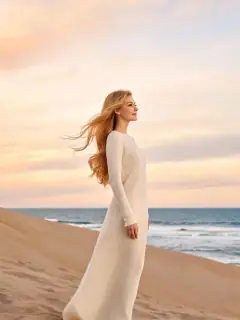
Made with MiniMax H3Cream knit dress on a sand dune: a wide bell of fabric, hair flying, a big smile.Made with MiniMax H3Emerald pleated skirt in a grey studio: a full circle of pleats, landing with a broad smile. What we saw when we tested Twirl
The first example is a woman in a long cream knit dress on a sand dune: she spun once, the fabric flared into a wide bell with her hair flying out over the first two seconds, and she landed facing the camera with a big smile as the hem settled around her ankles. The second is a young woman with short curls in an emerald pleated skirt in a grey studio: she whipped into a quick turn, holding the skirt out so it opened into a full circle, and landed facing the camera with a broad smile by second four.
Long and pleated skirts both flared beautifully, and the slow settle at the end looked graceful in each run.
The full-length framing held for the whole spin, so nothing got cropped.
How Twirl does on each model
- MiniMax H3 (210 credits · about 60 s) Both examples. The flare peaks in the first two seconds, the smile and slow settle follow.$0.21 vs Runway $0.50 · 768p · 5s−58% vs Runway
- MiniMax H3 · 4s (168 credits · about 60 s) Less time for the fabric to settle in slow motion.$0.21 vs Runway $0.50 · 768p · 5s−58% vs Runway
- Seedance 2.0 Mini · 480p (125 credits · about 3 min) Fabric folds soften at 480p; the circle of the skirt still reads.$0.13 vs fal $0.36 · 480p · 5s−65% vs fal
The prompt behind Twirl
The main subject does one quick, graceful twirl on the spot so the hem of the skirt or dress flares out in a circle, then lands facing the camera with a smile. The camera holds a full-length framing as the fabric settles in slow motion.
Tips for a better Twirl result
- Wear a skirt or dress with movement: pleats, chiffon or a long knit.
- Full-length framing with your shoes visible is a must.
- An outdoor breeze or a plain studio both work; avoid clutter close by.
Twirl: questions and answers
Does Twirl work with trousers?
It runs, but there is no hem to flare. Skirts and dresses give the real effect.
How many spins are there?
One quick spin, then a slow-motion settle.
Does my hair move too?
Yes, long hair flies out with the turn.
Is it good for a dress shop?
Yes, for a quick animated view of the dress’s movement and silhouette. The back is generated, so check its details.
Twirl or Outfit Check?
Twirl is a fast spin for flowing skirts; Outfit Check is a slower turn to show every side.
Related effects and tools
- Outfit Check · A full turn to show the look, then a hand-on-hip finish.
- Hair in the Wind · A strong gust whips your hair while you hold the stare.
- Glam Sweep · A quick arc that eases into slow motion on your best angle.
- Groove · Sharp footwork, a body wave, a spin and a hard pose.
- Try a new dress with AI Clothes Changer

 Your photo