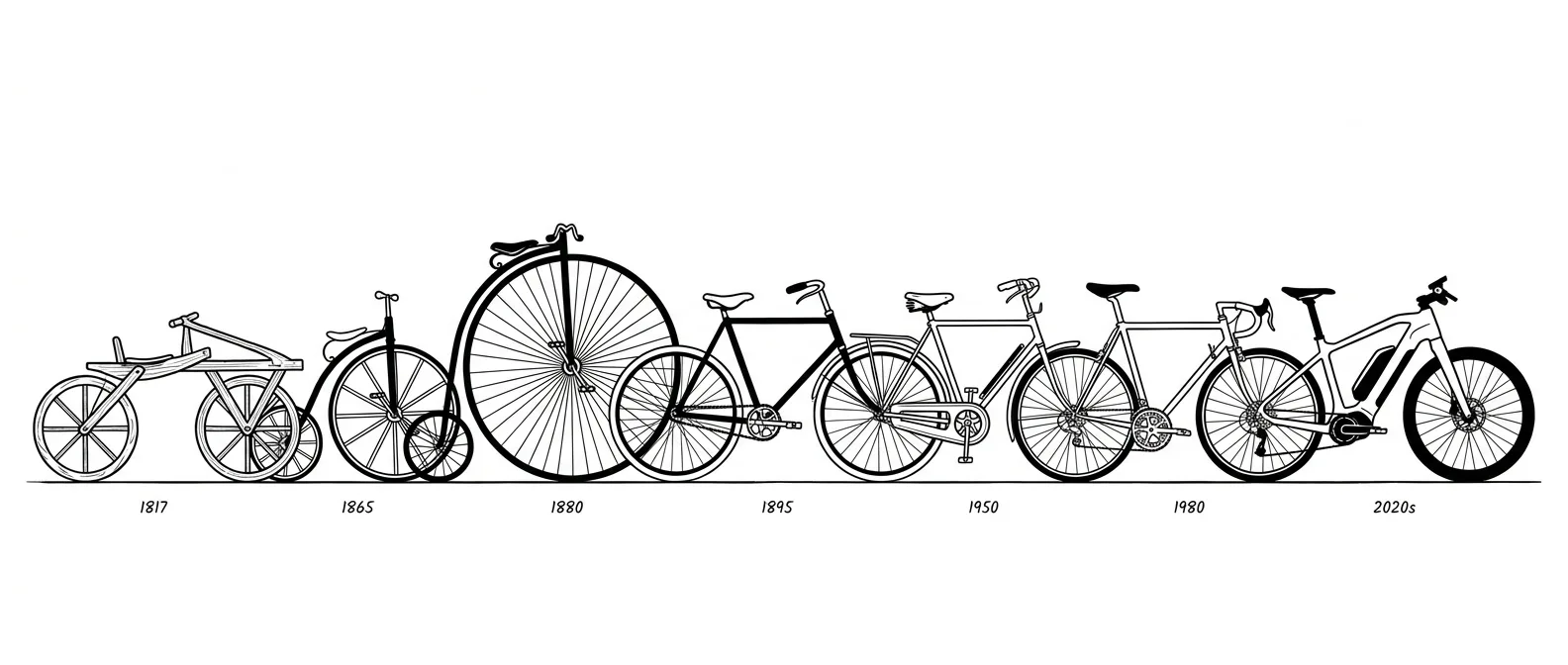
Evolution Chart, made with Nano Banana 2.1
Example made with Nano Banana 2.1

Text to imageInfographics & diagrams

Nano Banana 2.1 timeline infographic promptEvolution Chart

The exact text-to-image prompt behind this picture, made with Nano Banana 2.1.

Fill in the blanks

Change any box and the prompt below updates. Copy it, or make one with your version.

Prompt

An evolution chart in a minimalist black-and-white style: a row of seven large side-view illustrations that fill the full width of the frame, standing on one shared baseline, showing the bicycle changing step by step from a wooden running machine from the 1810s on the far left to a modern carbon e-bike on the far right. Each stage is a little more advanced than the one before, with a tiny year label under each. Clean ink illustration on white, no other text.

Prompts stay in English, the language these models follow best. Copy it as it is, or change a few words.

Opens Nano Banana 2.1 with this prompt and the settings below filled in.

91 tested Nano Banana prompts →

Settings

Mode
Text to image
Aspect ratio
21:9
Resolution
1k
Price
From 48 credits

The exact price shows before you generate.

Make your own version

  1. The layout is spelled out piece by piece: a row of seven large side-view illustrations that fill the full width of the frame. Keep that structure and change only the content, or the model loses track of the page.
  2. This is a fill-in template: swap the parts in braces, like {subject}, in the boxes above and keep the rest word for word.
  3. minimalist black-and-white style sets the whole feel of the shot. Swap it for another camera style to change the vibe.

Where this template comes from

Adapted from a prompt by @ZHO_ZHO_ZHO, collected in PicoTrex/Awesome-Nano-Banana-images under CC BY 4.0. PopNow rewrote it as a fill-in template and made the example above.

Style prompt guide

Style traits to keep

Seven black-and-white ink bicycles stand in one row on a shared baseline, from an 1810s wooden running machine on the left to a modern carbon e-bike on the right. Nano Banana 2.1 holds this together because the prompt fixes the layout, stage order and palette in plain terms, so each drawing can be a little more advanced than the last. The year labels are the only text, so sharp text rendering is what matters most here.

The style rests on four traits the prompt spells out. Check for each one in the finished chart before you change any wording.

Palette
Pure black ink on white with no colour, so the chart reads like a diagram rather than a painting. Adding a colour word, such as warm tones, would move the image toward a poster.
Line
Clean ink illustration gives even outlines with no texture or shading, so each bike is easy to compare with its neighbour. Adding 'with soft shading' would blur the timeline into a sketch.
Composition
Seven side-view bikes fill the full width of the frame on one shared baseline, which lets the eye read the change left to right. Without the baseline, the bikes can drift to different heights and the sequence weakens.
Detail
A tiny year label under each stage gives the chart its timeline without adding any other text. Making the labels large would pull attention from the bikes and turn the chart into a headline poster.

What defines this look

  1. Format and seven-stage layoutAn evolution chart in a minimalist black-and-white style: a row of seven large side-view illustrations that fill the full width of the frame

    Sets the chart format and the black-and-white palette, and the full-width row of seven gives the viewer a timeline at a glance. Remove the palette words and the model may add colour, which breaks the minimalist look.

  2. Shared baseline and storystanding on one shared baseline, showing the bicycle changing step by step

    Standing on one shared baseline keeps all seven bikes at the same height so the change reads left to right. Without it, the bikes are likely to float at uneven heights, and the step-by-step idea gets weaker.

  3. Start and end stagesfrom a wooden running machine from the 1810s on the far left to a modern carbon e-bike on the far right

    This names the first and last stages, so the model knows the bicycle must go from a wooden running machine to a carbon e-bike. Change either end and the whole timeline changes with it.

  4. Progression and year labelsEach stage is a little more advanced than the one before, with a tiny year label under each

    Each stage improves only slightly on the last, and the tiny year label dates every step. Drop the labels and the timeline loses its dates, while 'a little' changed to 'much' makes the jumps look uneven.

  5. Finish and no-text ruleClean ink illustration on white, no other text.

    Clean ink illustration on white sets the finish, and 'no other text' stops the model from adding titles or captions beyond the years. Drop 'no other text' and expect a title block or legend to appear.

Same style, new subjects

Hairstyle timeline

Keeps the same layout and ink finish with a person's hairstyle as the subject, which suits a barbershop or fashion history poster.

Prompt

A hairstyle evolution chart in a minimalist black-and-white style: a row of seven large side-view illustrations that fill the full width of the frame, standing on one shared baseline, showing an adult's hairstyle changing step by step from a 1810s powdered wig on the far left to a modern short crop on the far right. Each stage is a little more advanced than the one before, with a tiny year label under each. Clean ink illustration on white, no other text.

Dog breed timeline

Keeps the style and layout but swaps in an animal, which suits a pet-care or breed history handout.

Prompt

A dog evolution chart in a minimalist black-and-white style: a row of seven large side-view illustrations that fill the full width of the frame, standing on one shared baseline, showing a dog changing step by step from a wild wolf on the far left to a modern pet dog on the far right. Each stage is a little more advanced than the one before, with a tiny year label under each. Clean ink illustration on white, no other text.

City street timeline

Keeps the same layout and ink finish for a place rather than an object, which suits a local history or urban planning display.

Prompt

A city street evolution chart in a minimalist black-and-white style: a row of seven large side-view illustrations that fill the full width of the frame, standing on one shared baseline, showing a city street changing step by step from a dirt road with horse carts on the far left to a modern street with electric buses on the far right. Each stage is a little more advanced than the one before, with a tiny year label under each. Clean ink illustration on white, no other text.

Model and settings

Keep the 21:9 ratio, since the seven bikes need the full width to read as one timeline. Use t2i with no start frame or input pictures, because this chart is built from text alone. The example used 1k, so start there and raise the resolution only if the tiny year labels need to be crisper for print or a large display. If you want a square or portrait version, change the ratio, but expect the seven bikes to get smaller and the year labels harder to read.

  • Nano Banana ProPick this if you want more stages in the row, since its tagline says it plans the layout first, which helps keep extra bikes evenly spaced on one baseline.
  • GPT Image 2.5 SunburstPick this when the year labels must be perfectly clean for print, since its tagline stresses quality first and clean text, which suits this same no-other-text chart.

When the style drifts

The seven stages look like one bike with small tweaks, not a clear evolution.
Change 'a little more advanced' to 'clearly more advanced' so each step shows a visible jump in design.
The style drifts into a shaded cartoon or a coloured poster.
Keep 'Clean ink illustration on white' and add 'no shading and no colour' before the final full stop.
Titles, captions or a legend appear beyond the year labels.
Keep 'no other text' as the last words and, if extra words still show, add 'year labels only' after 'a tiny year label under each'.
The bikes sit at different heights or sizes and break the row.
Keep 'standing on one shared baseline' and 'fill the full width of the frame', and keep the 21:9 ratio.

Questions about this style prompt

Will Nano Banana 2.1 draw a believable 1810s wooden running machine?

The prompt names the 1810s running machine but gives no detail about its frame or wheels, so the first bike can look like a generic old cycle. If it reads as a modern bike, add 'two wooden wheels and no pedals' to the far-left stage wording and generate again.

How should I write the year labels so they stay readable?

Keep each label to a plain year or decade, such as 1810s, with nothing around it. If a label comes out unreadable, change only the word 'tiny' to 'small' and regenerate. The prompt sets only the 1810s start, so the model picks the other years; name them if you want exact dates.

Can I reuse this prompt for a different vehicle, like a car?

The layout and ink rules do not depend on the bicycle, so they carry over unchanged. Swap the subject in the opening and rewrite both end stages, keeping the old-to-modern order, so the progression still reads clearly.