


Japanese Wabi-Sabi AI Photo Generator: Quiet Clay
Raw clay, old wood and calm empty space.
- From a description only
- Best shape: 4:5 · 3:4
Works on
- Seedream 5.0 Pro
- Qwen Image 3.0
- Nano Banana 2.1
- Seedream 5.0 Flash
About Quiet Clay
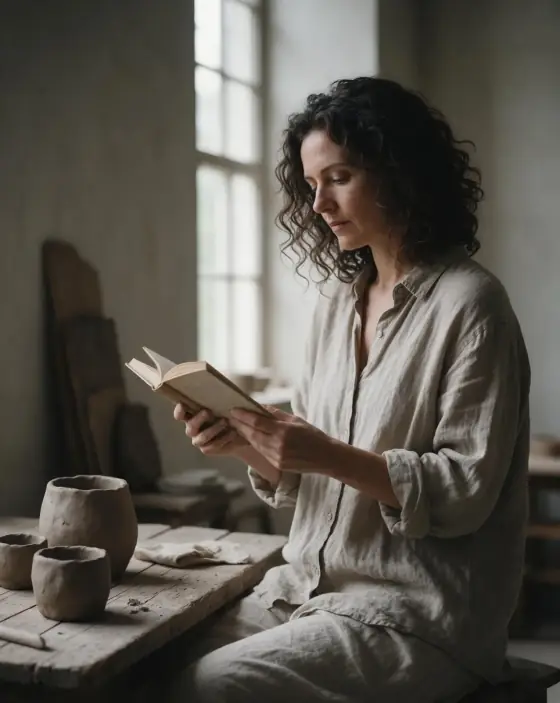
Quiet Clay is the Japanese idea that beauty lives in things that are simple, imperfect and a little worn — made into a photograph. Raw clay, aged wood and undyed linen fill the frame; soft north-facing window light falls evenly, without hard shadows; the palette stays in muted earth tones, from oatmeal to charcoal. The composition is asymmetric and leaves generous empty space, so the eye rests instead of racing.
You write the subject; the style supplies the room and the stillness. It suits slow, everyday moments: someone reading in a linen shirt by a paper-screened window, a man standing quietly by a bare plaster wall, a cat asleep on a worn wooden sill, a single ceramic bowl on a low table. Nothing is polished and nothing shouts — the imperfection is the point.
Use it for ceramics and craft brands, tea and coffee shops, interiors, slow-living posts, book covers and product shots that should feel handmade and calm. For airy, sun-washed film photos, use Airy Film; for mist and grey-green haze, Deep Fog; for bold flat color from the woodblock tradition, Woodblock Print.
Subjects to paste as they are: “a handmade clay teapot and two cups on a low wooden table”, “a woman in a loose linen shirt reading by a window”, “a single branch in a stoneware vase against a plaster wall”. One or two natural materials are all it needs.
Finishes that work on top: Film grain for a quieter, more analog texture. Skip Golden hour; its warm glow breaks the even north light.
Tips
- Name natural materials: clay, linen, aged wood, stone, paper. The style is built around their texture.
- Keep the scene sparse — one object, one person, one plant. Empty space is part of the look.
- Slow actions only: reading, pouring tea, sitting, looking out. Anything energetic breaks the calm.
- For products, add “on a worn wooden surface” or “against a plaster wall”; the soft light does the rest.
- If the result looks too dim, add “on a bright overcast morning” to your subject.
What the style adds
Your words go where it says “your subject”. Everything else is added for you.
your subject, wabi-sabi still photograph, raw clay, aged wood and undyed linen textures, soft north-facing window light, muted earth palette, asymmetric composition with generous empty space, unhurried calm
Models and price
- Seedream 5.0 Pro36 credits
- Qwen Image 3.030 credits
- Nano Banana 2.148 credits
- Seedream 5.0 Flash29 credits
One 1K image from a description. The button always shows the exact price before you spend anything.
How to use Quiet Clay
- Describe itWrite who or what should be in the picture. A small action and a clear place work best.
- Pick a shapeKeep the suggested ratio and model, or change them in the bar at the bottom.
- Paint itPress “Paint it”. The price is on the button before you spend anything.
Questions about Quiet Clay
Can I use Quiet Clay on my own photo?
Not yet. This style works from a description: write what you want to see and the style adds the look.
How much does one Quiet Clay image cost?
29 credits for one 1K image on Seedream 5.0 Flash. 2K costs more, and the button shows the exact price before you run it.
Will this style change how the person looks?
No. The template describes materials, light, palette and composition only. The style borrows an aesthetic tradition, never a look for people; whoever you write keeps the same features and clothing.
Does it only work for traditional interiors?
No. Wabi-sabi is about materials and light, not a place. A farmhouse kitchen, a studio loft or a quiet beach all work, as long as you name worn, natural textures.
How is it different from Airy Film?
Airy Film is bright and sun-washed, with the soft pastel feel of film photography. Quiet Clay is quieter and earthier: north light, raw materials and far more empty space.
Similar styles
 Blue Hour
 Deep Fog
 Window Light
 Sunny Café
Bring it to life
Effects that turn a still in this look into a short video.
 Slow Push-In
 Live Portrait