


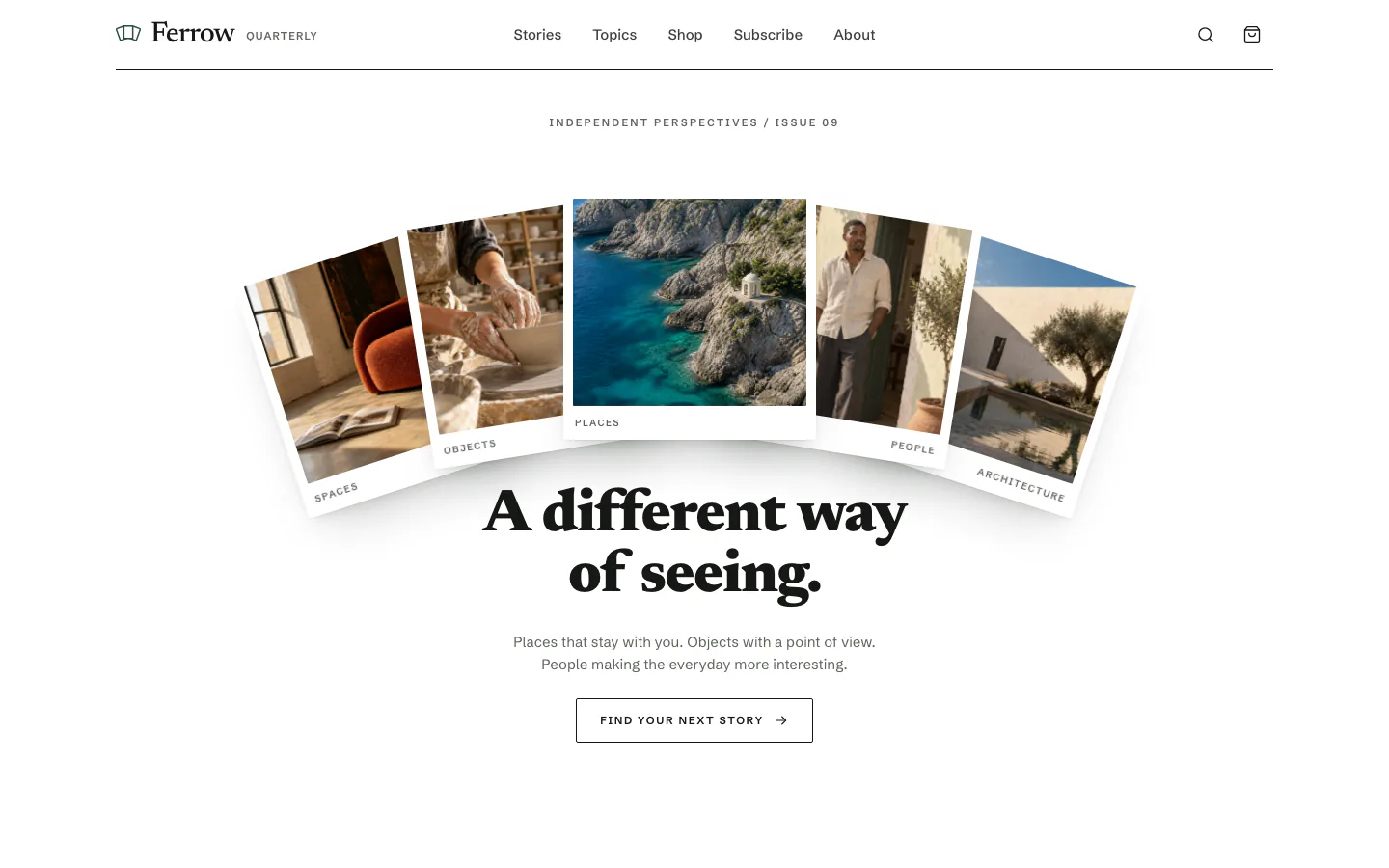
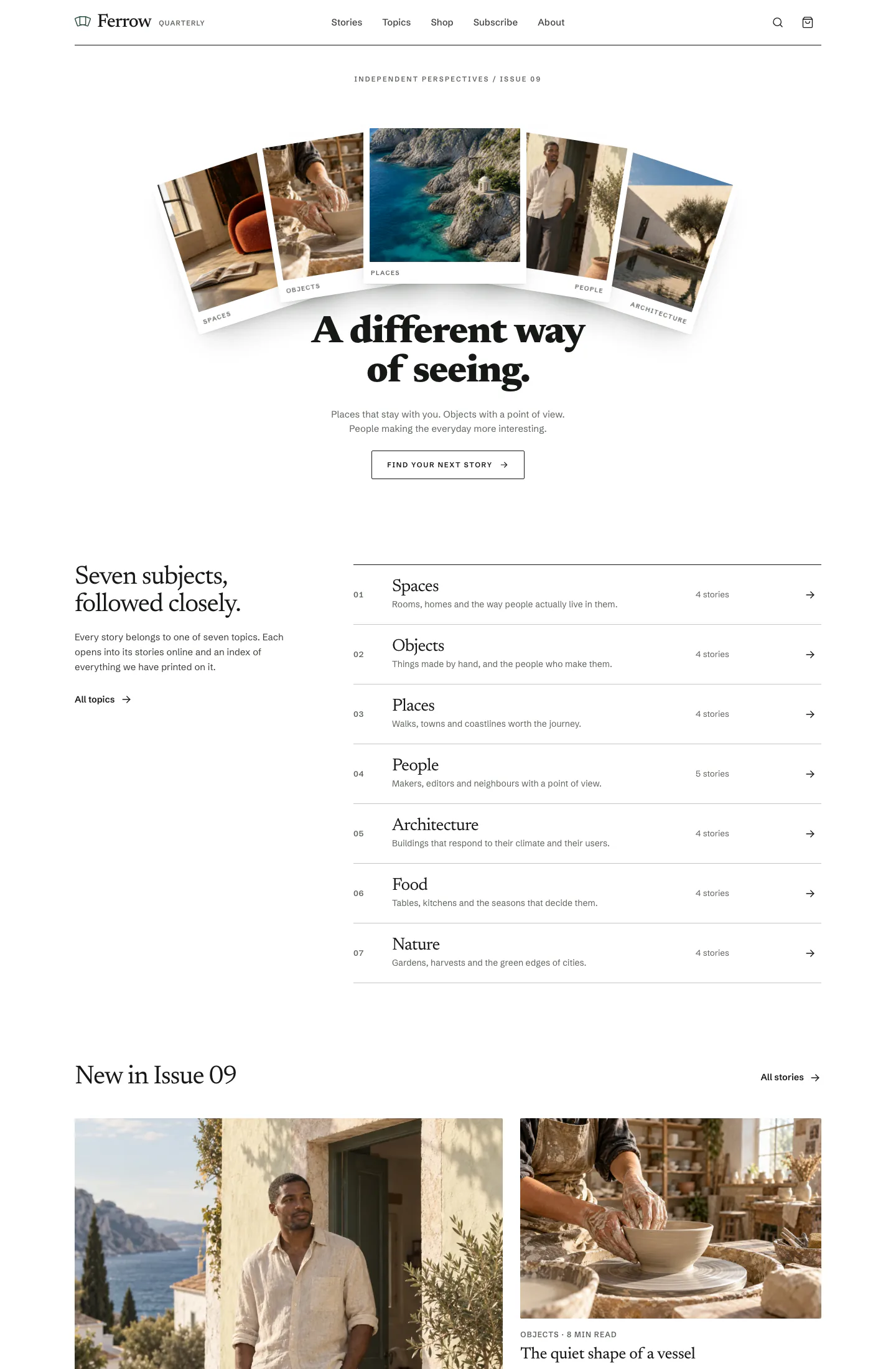
What you get
- One HTML file with fonts and photos embedded, or a Next.js, React, Vue or Astro port
- Home, stories, article pages, topics with a print archive and a designed 404
- Shop with issue covers and framed prints, bag, demo checkout and subscription plans
- About, contact, newsletter, FAQ, delivery and legal pages
- A validator for links, structure, offline safety and leftover sample names
Good for
- Independent magazines, quarterlies and newsletters
- Studio or maker journals with a small shop
- Travel, city guide and food brands that publish stories
Not for
- News sites that publish many times a day
- Blogs that need a content management system from the start
- Dark, loud or heavily animated brand identities
How to use it
In Claude or ChatGPT
Use the PopNow skill "Magazine Website Template" (magazine-website) for this: Build a site for Tidelines, a twice-yearly print journal about small harbour towns, with five stories, a shop for back issues and a yearly subscription.
In a coding agent
/popnow-magazine-website Build a site for Tidelines, a twice-yearly print journal about small harbour towns, with five stories, a shop for back issues and a yearly subscription.
Then try
Plan the story photos in a cool northern light instead, and quote me before generating.
Move the site into my Astro project and keep the articles as Markdown.
What to have ready
- Publication name, audience and around seven topics
- At least three stories with titles, summaries and text
- Products, plans and delivery rates if you sell anything
- Your photos, or a PopNow API key to generate them
Similar skills
View all →3D Avatar Maker
+3Build a cute soft-toy 3D character in your browser and save it as a transparent PNG or a 3D page.
Calendar Heatmap
+3A year of daily activity as a shaded calendar grid, with streaks, totals and keyboard access.
AI SaaS Landing Page
+3Warm sand paper, hairline rails and hatched gutters around a live kanban board where an assistant plans tasks.
Animated Hero Section
+3A landing-page hero with a gently rotating headline word, two buttons and a wide image frame.
Shader Hero Agency Website
+3A live orange-heat shader hero behind a bottom-pinned statement, pill nav and a staggered case-study grid.
Dark SaaS Landing Page
+3A dark, motion-rich marketing site for a software product, delivered as one self-contained HTML file.
Designer Portfolio Website
+3Six tilted cards hover round a fading headline on calm grey, one red portrait card, editorial case studies.
Developer Portfolio Website
+3A dark personal site for engineers with case studies, writing, talks, a résumé and a contact form.
Editorial SaaS Website
+3Navy split hero, a five-line serif headline beside a documentary still, slanted bands and one cobalt accent.
Glassmorphism Website Template
+3Frosted glass pills on a near-black film, a huge serif headline with one italic word and an email capture.
Hardware Product Website
+3Huge hairline model names on silver studio shots, frosted spec cards, a to-scale lineup and a hardware bento.
Interactive Architecture Diagram
+3An offline, clickable system diagram built from a checked JSON model, with the evidence behind each box.
Interactive Grid Hero
+3A dark grid of fine strands that bends toward the cursor and rolls a glowing ring out from every click.
Knowledge Graph Explorer
+3Turn project notes into an offline, searchable graph where every claim links back to its source line.
KPI Dashboard Template
+3Four KPI tiles with change chips over a glowing line chart, a breakdown table and target bars on warm paper.
Landing Page from AI Mockups
+3See three full-page designs first, pick one, and your agent builds it as clean, responsive code.
Particle Animation Hero
+3Copy on warm paper beside a turning sphere of ink and teal dots that reshapes per idea and scatters on scroll.
Personal Brand Website
+3A portrait feathered into warm paper under a thin bracket, with light-and-bold statements on either side.
Cinematic Product Launch Page
+3Film-lit near-black page: serif title card over drifting light, letterboxed night scene, reservation form.
Admin Dashboard Template
+3A working back-office console with charts, tables, kanban and calendar, built as one offline HTML file.
SaaS Landing Page Template
+3A calm, light marketing site for a software product with a working product console, pricing and sign-up.
Scrapbook Portfolio Website
+3A multi-page online CV made of paper objects, with case studies and a printable resume.
Sneaker Store Website Template
+3A complete footwear or apparel shop with catalog, product pages, bag and demo checkout in one HTML file.
Workflow Automation Landing Page
+3Graphite page, small left-aligned headline, and a live node graph below that runs, retries and streams logs.
Questions
Can I run it without a backend?
Yes. The default output is a single HTML file. Search, filters, saved stories and the bag work in the browser; checkout, subscriptions and forms show clear demo confirmations until you connect real services.
What does PopNow generate here?
Story photographs, cover still lifes and stand-in masthead portraits, all in one art direction. Covers and prints are assembled in HTML, so images never need text. Each run is quoted first and starts only after you agree.
Does it suit a business that is not a magazine?
Often. Stories can become journal entries, guides or origin reports, topics become techniques, neighbourhoods or regions, and the subscription becomes a membership or delivery plan.
What happens to the sample magazine content?
It is replaced. The validator fails if any sample name, person, stockist, place or story title is still in the page, and anything the skill had to invent is listed for you.