

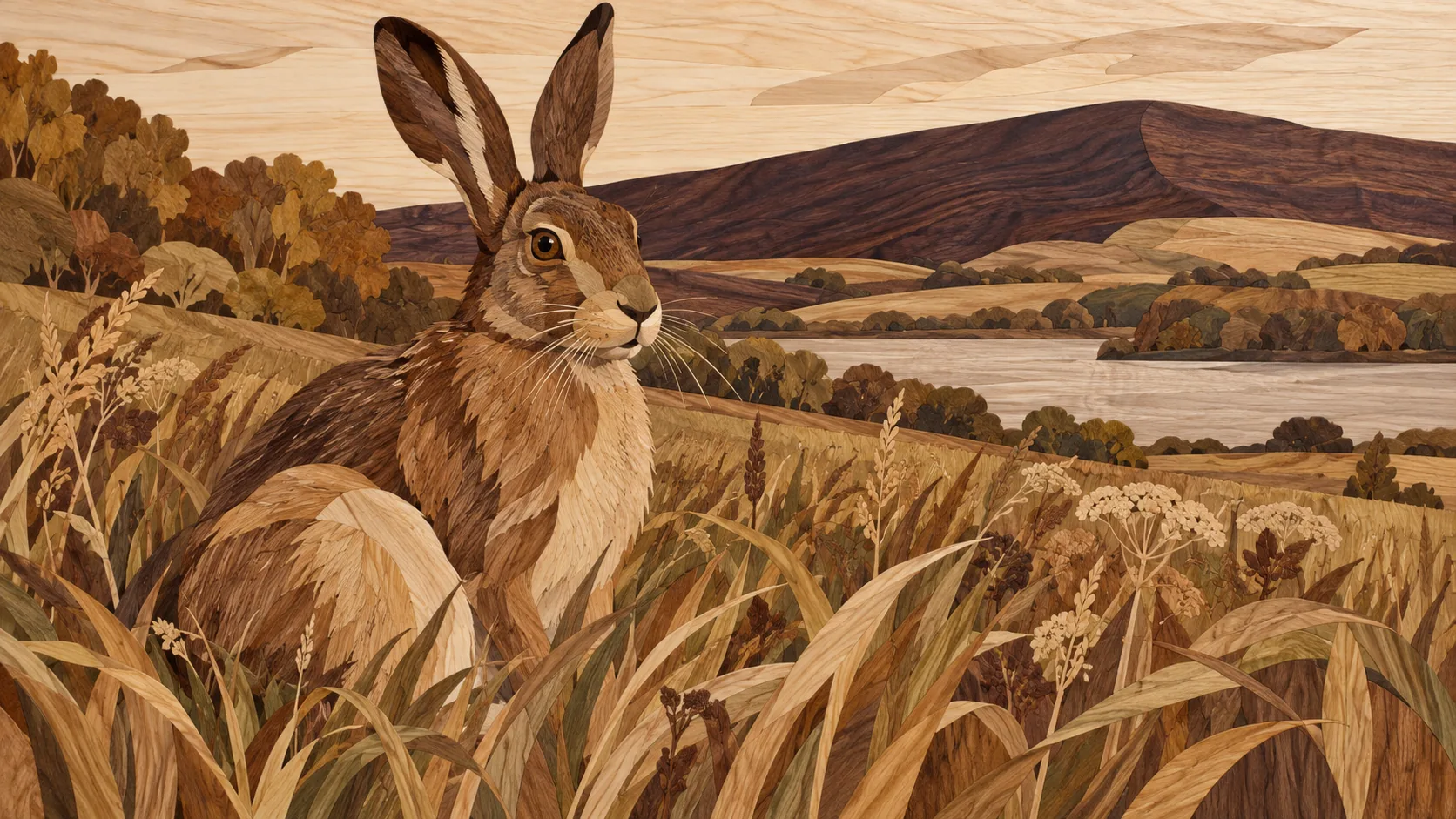

Hare In Veneer, made with GPT Image 2.5 Sunburst
Example made with GPT Image 2.5 Sunburst

Text to imageArt & posters

GPT Image 2.5 Sunburst art style promptHare In Veneer

The exact text-to-image prompt behind this picture, made with GPT Image 2.5 Sunburst.

Prompt

Wide 16:9 landscape frame. A resting hare sits among broad meadow grasses in an intricate wood marquetry landscape, walnut ears and maple flanks set against pale ash ground and a dark plum-stained hill. Let the grain direction describe fur and wind without drawn outlines. Straight-on artwork reproduction with soft raking daylight, satin wood texture and carefully fitted seams, serene early autumn color and understated craft precision, no text.

Prompts are kept in their original English to help reproduce the example. Copy one as it is, or adapt it for your project.

Opens GPT Image 2.5 Sunburst with this prompt and the settings below filled in.

135 tested GPT Image prompts →

Settings

Mode
Text to image
Aspect ratio
16:9
Quality
high
Price
From 2 credits

The exact price shows before you generate.

Make your own version

  1. The prompt ends with no text. Leave that in, or the model may add random lettering.

Style prompt guide

Style traits to keep

A resting hare handcrafted from contrasting timber veneers forms the centerpiece of a traditional wood marquetry landscape. GPT Image 2.5 Sunburst faithfully translates individual wood species, using walnut, maple, and ash grain orientation instead of ink lines to define contours. The result looks like museum-grade craftwork rather than an illustration, preserving tactile satin finishes and inlaid seams under gentle daylight.

Wood marquetry creates complex imagery exclusively through thin veneer sheets cut and assembled like an intricate jigsaw puzzle. Its beauty relies on natural organic fibers and flush joints rather than applied brushstrokes or carved depth.

Texture
Natural wood pores and distinct grain directions flow across individual veneer shapes, mimicking fur and blowing grass without synthetic gradients.
Line
Tight, flush joints between contrasting wood pieces define all edges, eliminating artificial ink outlines or drawn borders entirely.
Light
Soft raking daylight glances across the flat satin panel, catching subtle micro-edges at the seams to emphasize that this is physical woodwork.
Palette
Earthy tones drawn from specific lumber species like walnut, maple, and ash provide warmth, balanced by a subtle dyed plum accent for depth.

What defines this look

  1. subject and craft mediumWide 16:9 landscape frame. A resting hare sits among broad meadow grasses in an intricate wood marquetry landscape,

    This establishes the horizontal canvas and the primary woodworking discipline. Changing marquetry to wood carving or painting turns the piece into a sculptural relief or an ordinary picture.

  2. palette and wood assignmentwalnut ears and maple flanks set against pale ash ground and a dark plum-stained hill.

    This assigns specific natural wood types to distinct anatomical and background elements. Removing these timber names causes the model to generate uniform, generic brown tones across the scene.

  3. inlay technique directiveLet the grain direction describe fur and wind without drawn outlines.

    This instructs the engine to emulate true veneer work where fiber orientation suggests movement. Without this, the generator defaults to drawing black illustrative outlines around each shape.

  4. lighting and surface finishStraight-on artwork reproduction with soft raking daylight, satin wood texture and carefully fitted seams,

    This ensures the camera captures the panel squarely without dramatic perspective distortion. The raking daylight catches tight joints and the low-sheen satin finish, reinforcing authentic physical craftsmanship.

  5. mood and negative restraintserene early autumn color and understated craft precision, no text.

    This governs the emotional temperature of the palette and enforces clean visual execution. Omitting the precision phrase often invites messy joint gaps and unintentional carved embellishments.

Same style, new subjects

Historic city street

Applies the marquetry technique to an architectural cityscape to test sharp angular veneer cutting.

Prompt

Wide 16:9 landscape frame. A quiet tramline cuts past brick storefronts in an intricate wood marquetry landscape, ebony tracks and cherry facades set against pale ash pavement and a dark indigo-stained sky. Let the grain direction describe wet reflections and building facades without drawn outlines. Straight-on artwork reproduction with soft raking daylight, satin wood texture and carefully fitted seams, serene early dusk color and understated craft precision, no text.

Rustic kitchen still life

Shifts the medium to a domestic still life where organic fruit shapes contrast with tabletop textures.

Prompt

Wide 16:9 landscape frame. A ceramic pitcher and sliced figs rest on a table in an intricate wood marquetry landscape, birch pottery and mahogany fruit set against pale ash cloth and a dark olive-stained background. Let the grain direction describe smooth ceramic and table grain without drawn outlines. Straight-on artwork reproduction with soft raking daylight, satin wood texture and carefully fitted seams, serene autumnal color and understated craft precision, no text.

Seated artisan portrait

Transfers the timber inlay style to an adult human figure, relying on grain angle to suggest fabric.

Prompt

Wide 16:9 landscape frame. A seated artisan carves at a low workbench in an intricate wood marquetry landscape, walnut apron and maple profile set against pale ash studio walls and a dark cedar-stained cabinet. Let the grain direction describe cloth folds and posture without drawn outlines. Straight-on artwork reproduction with soft raking daylight, satin wood texture and carefully fitted seams, serene morning color and understated craft precision, no text.

Model and settings

Keep the aspect ratio at 16:9 to give the horizontal landscape ample space for layered meadow grasses and background hills. Retain high quality so GPT Image 2.5 Sunburst renders micro-textures in the timber fibers, authentic sheen variations, and crisp flush seams. If you reframe the prompt around an isolated single portrait or still life, switch the aspect ratio to 1:1 or 4:5 while leaving the quality setting on high.

  • FLUX.2 ProFLUX.2 Pro is ideal if you want exact hex color control over specific stained veneer dyes and maximum photographic realism on the wood surface.
  • Seedream 5.0 ProSeedream 5.0 Pro works best when you want to feed multiple real timber reference photos to dictate exact wood grains and joint patterns.

When the style drifts

The animal renders as an illustrated or painted cartoon overlaid with a wood grain filter.
Change 'A resting hare sits' to 'A flat inlaid silhouette of a resting hare' and add 'composed strictly of interlocking wood veneers'.
The generator adds heavy 3D carved bevels, making the artwork look like a bas-relief plaque.
Remove any mention of depth and add 'completely flat two-dimensional surface with flush, level joints' after 'satin wood texture'.
Drawn black ink lines appear around the subject instead of seamless wood joins.
Replace 'without drawn outlines' with 'zero painted borders, zero ink lines, edges formed exclusively by touching veneer pieces'.

Questions about this style prompt

Why does the prompt name specific lumber like walnut and maple?

Naming genuine timber species guides GPT Image 2.5 Sunburst to render authentic grain densities, pore structures, and native color values. Generic terms like brown wood often produce artificial plastic laminate patterns.

How can I prevent the result from looking like a relief carving?

Keep phrases like 'wood marquetry' and 'carefully fitted seams' intact. Marquetry specifically denotes flat flush veneer work, whereas terms like woodwork or wood art frequently trigger deep sculptural 3D carving.

Can I change the colored hill to a different shade?

Yes. Replace 'dark plum-stained hill' with other traditional timber dye terms such as 'moss-green-stained hill' or 'indigo-dyed oak hill' while maintaining the natural timber names for the foreground elements.