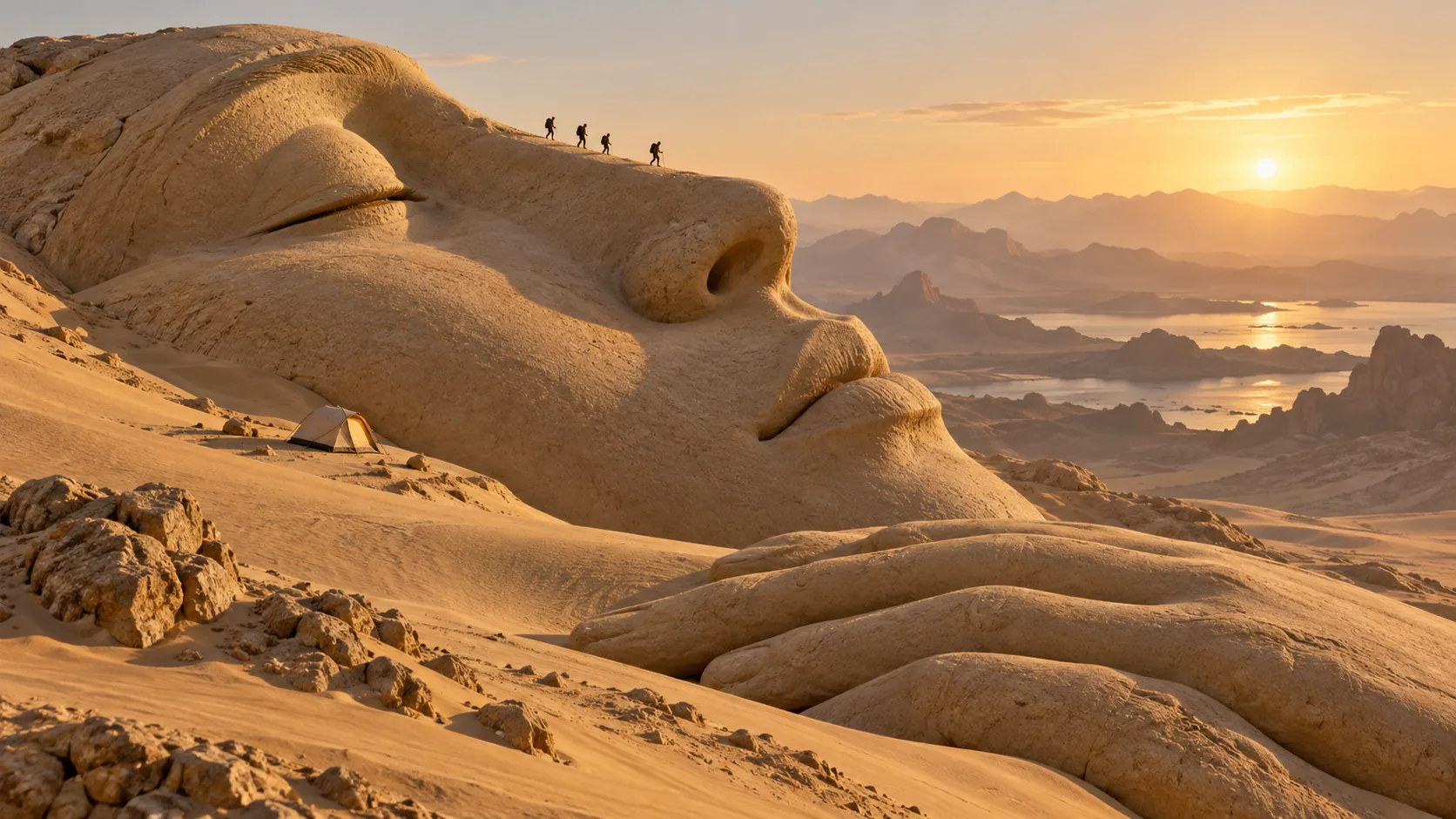
Sleeping Giant Hills, made with GPT Image 2.5 Sunburst
Example made with GPT Image 2.5 Sunburst

Text to imageSurreal & fun

GPT Image 2.5 Sunburst surreal photo promptSleeping Giant Hills

The exact text-to-image prompt behind this picture, made with GPT Image 2.5 Sunburst.

Prompt

Wide 16:9 landscape frame. A monumental single-color landscape in soft sand tones formed from the gentle curves of a giant resting face and folded hands, tiny hikers walking along the ridge of the nose, a little tent pitched near the cheek, soft low sunlight, minimalist surreal photography, no text.

Prompts are kept in their original English to help reproduce the example. Copy one as it is, or adapt it for your project.

Opens GPT Image 2.5 Sunburst with this prompt and the settings below filled in.

135 tested GPT Image prompts →

Settings

Mode
Text to image
Aspect ratio
16:9
Quality
high
Price
From 2 credits

The exact price shows before you generate.

Make your own version

  1. For a different mood, rewrite only the light: soft low sunlight.
  2. minimalist surreal photography sets the whole feel of the shot. Swap it for another camera style to change the vibe.
  3. The prompt ends with no text. Leave that in, or the model may add random lettering.

Where this idea comes from

Inspired by an idea from @VigoCreativeAI, collected in VigoZhao/AI-Visual-Prompt-Cookbook under CC BY 4.0. PopNow wrote this prompt and made the example above.

Scene prompt guide

How the scene is composed

A giant sleeping human profile sculpts an expansive desert dune landscape with microscopic travelers trekking across facial features. It blends landform geometry and human anatomy seamlessly through a monochromatic sand palette, allowing OpenAI's GPT Image 2.5 Sunburst to prioritize smooth sculptural gradients and extreme scale contrasts without visual clutter.

  1. composition and color paletteWide 16:9 landscape frame. A monumental single-color landscape in soft sand tones

    Establishes an expansive panoramic ratio and a unified sand-dune color scheme. Removing this creates harsh multi-colored terrain that distracts from the smooth sculptural curves.

  2. surreal subject geometryformed from the gentle curves of a giant resting face and folded hands,

    Instructs the generator to shape the physical hills into human anatomy rather than adding a separate giant figure. Changing this to sharp peaks loses the subtle illusion.

  3. scale and narrative detailtiny hikers walking along the ridge of the nose, a little tent pitched near the cheek,

    Provides essential reference objects that prove the massive size of the terrain features. Without these tiny elements, the image looks like an ordinary close-up portrait in sand.

  4. lighting and style constraintssoft low sunlight, minimalist surreal photography, no text.

    Casts gentle raking shadows that define facial contours across dunes while keeping the overall aesthetic clean and uncluttered by unwanted graphic watermarks.

Camera and light

Lighting and camera angle dictate how naturally the colossal human contours blend into desert dunes.

Light
Low-angle raking sunlight skims across the sand ridges, casting long, soft shadows that define facial slopes without harsh contrast.
Camera
A distant eye-level landscape perspective keeps the horizon broad and balances the resting anatomy across the frame.
Scale
Extreme proportional contrast between tiny human travelers and the colossal face sells the optical illusion of living geology.
Mood
Monochromatic, quiet sand tones and vast empty space produce a serene, dreamlike atmosphere rather than an ominous fantasy scene.

Variations on the scene

Snow Tundra Giant

Swaps the warm sand palette for cold arctic snow at twilight to create a serene winter expedition aesthetic.

Prompt

Wide 16:9 landscape frame. A monumental single-color landscape in crisp white snow tones formed from the gentle curves of a giant resting sleeping woman and folded arms, tiny mountaineers trekking along the ridge of the jawline, a glowing orange base camp tent on the shoulder slope, soft blue twilight illumination, minimalist surreal photography, no text.

Sleeping Bear Meadow

Replaces the human face with a sleeping animal form under morning light for an earthy, folklore-inspired setting.

Prompt

Wide 16:9 landscape frame. A monumental single-color landscape in muted sage green tones formed from the gentle curves of a colossal curled sleeping bear, tiny backpackers walking along the ridge of the spine, a small red tent pitched near the paw, golden hour morning light, minimalist surreal photography, no text.

Starlit Aerial Profile

Elevates the viewpoint to a high-angle night shot with luminous expedition gear for a mysterious nocturnal mood.

Prompt

Wide 16:9 landscape frame. High-angle drone landscape in deep midnight blue tones formed from the gentle curves of a giant resting face emerging from smooth desert dunes, tiny explorers with glowing headlamps traversing the nose bridge, faint starlight and subtle rim lighting, minimalist surreal photography, no text.

Model and settings

Keep the aspect ratio at 16:9 to give the resting giant enough horizontal span for the facial profile and folded hands. Set the generation mode to text-to-image with high quality to preserve sharp contours on tiny hikers against the soft sand dunes. If you want a vertical wallpaper, switch the ratio to 9:16 and ensure the prompt describes a vertical sleeping figure or head orientation.

  • FLUX.2 ProSelect FLUX.2 Pro when you want ultra-photorealistic desert sand textures and precise control over monochromatic warm hex color values.

When the scene falls apart

The giant face looks like a literal person lying on normal sand dunes instead of terrain formed from dunes.
Reinforce words like 'monumental single-color landscape formed from the gentle curves' and ensure 'sand tones' is repeated so skin textures are replaced by dune sand.
The hikers appear gigantic, making the face look like a standard tabletop sand sculpture.
Add 'microscopic scale' or 'infinitesimally small hikers' before the hiking phrase to enforce an extreme size disparity.
Midday lighting washes out the contours, making the facial profile impossible to identify.
Change 'soft low sunlight' to 'low-angle raking sunlight casting long dune shadows' to carve out the eye sockets, nose, and lips.

Questions about this scene prompt

How do I prevent the model from adding skin texture to the giant face?

Specify a single-color sand material across the entire landscape and avoid words like skin, flesh, or portrait. Phrases like 'monumental landscape formed from sand curves' ensure the entire landform is rendered strictly as sculpted earth.

Can I add more miniature details without cluttering the composition?

Yes, you can include one or two small additions such as a tiny campfire, a narrow foot trail, or a miniature flag. Keep them small by using words like 'tiny', 'distant', or 'microscopic' so the minimalist landscape remains uncluttered.

Why does the giant landscape look like a normal mountain range with no recognizable face?

This happens when the anatomy description is too vague. Ensure you explicitly mention clear landmark features like 'the bridge of the nose', 'resting cheek', or 'folded hands' alongside low-angle directional lighting.