
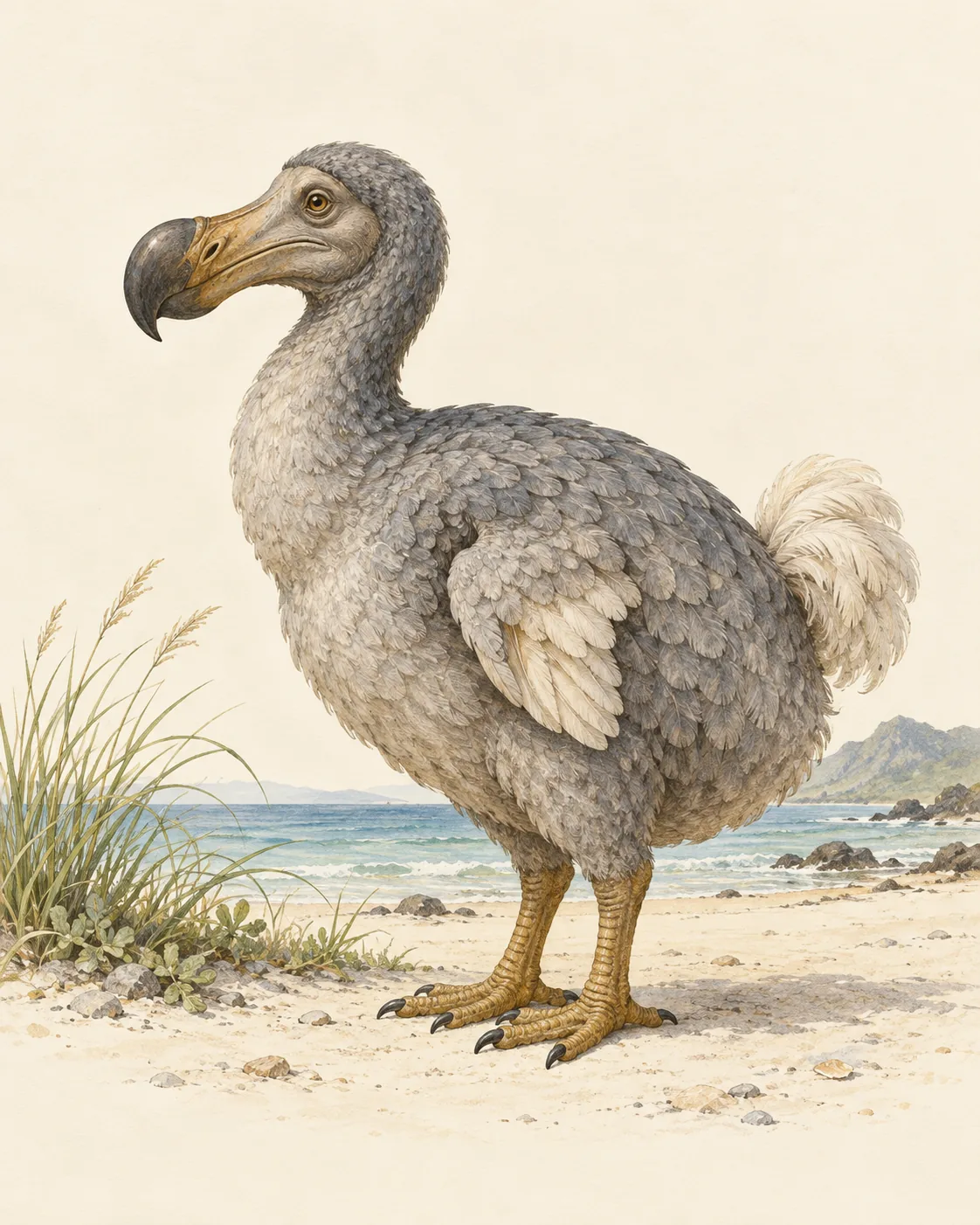
Dodo Coastal Study, made with GPT Image 2.5 Sunburst
Example made with GPT Image 2.5 Sunburst

Text to imageAnimals

GPT Image 2.5 Sunburst animal photo promptDodo Coastal Study

The exact text-to-image prompt behind this picture, made with GPT Image 2.5 Sunburst.

Prompt

Vertical 4:5 portrait frame. A dodo stands in profile on pale coastal sand beside a sprig of native grass, its layered grey feathers, cream tail tuft and strong ochre feet rendered with patient naturalist detail. Leave a broad unmarked margin around the single bird. Fine gouache and graphite on warm ivory paper, soft implied afternoon light, muted cobalt and sage washes, dignified curious presence, no text.

Prompts are kept in their original English to help reproduce the example. Copy one as it is, or adapt it for your project.

Opens GPT Image 2.5 Sunburst with this prompt and the settings below filled in.

135 tested GPT Image prompts →

Settings

Mode
Text to image
Aspect ratio
4:5
Quality
high
Price
From 2 credits

The exact price shows before you generate.

Make your own version

  1. For a different mood, rewrite only the light: soft implied afternoon light.
  2. The prompt ends with no text. Leave that in, or the model may add random lettering.

Where this idea comes from

Inspired by an idea from Heather Green, collected in YouMind-OpenLab/awesome-nano-banana-pro-prompts under CC BY 4.0. PopNow wrote this prompt and made the example above.

Scene prompt guide

How the scene is composed

A single dodo in profile on pale coastal sand, painted like a naturalist's plate in gouache and graphite on warm ivory paper. It works because the prompt fixes one subject, one pose, one medium and a wide empty margin, so GPT Image 2.5 Sunburst has no room to add clutter and spends its detail on feathers and feet.

  1. Subject and poseA dodo stands in profile on pale coastal sand beside a sprig of native grass

    Profile is the classic specimen view, so the whole body shape reads clearly. The grass sprig gives scale and place. Remove it and the bird floats; swap the pose and the plate look weakens.

  2. Anatomical detailits layered grey feathers, cream tail tuft and strong ochre feet rendered with patient naturalist detail

    Naming feather layers, tail tuft and feet colour tells the model where to put detail. Without these, the dodo tends to become a generic grey bird with vague legs.

  3. Empty marginLeave a broad unmarked margin around the single bird.

    This keeps the frame uncluttered and gives the page-like look of a museum plate. Drop it and the model may fill the edges with extra plants, shells or a full landscape.

  4. Medium and surfaceFine gouache and graphite on warm ivory paper

    Gouache gives matte opaque colour and graphite adds crisp outlines. The ivory paper sets the warm background. Change it to oil or watercolour and the whole texture changes.

  5. Light, palette, moodsoft implied afternoon light, muted cobalt and sage washes, dignified curious presence, no text.

    Implied light keeps shadows gentle instead of dramatic. Two named colours hold the palette tight. The closing no text stops invented captions or species labels, which plates often invite.

Camera and light

This is an illustration, not a photo, so camera and light are implied. You steer them through viewpoint words, light wording and how much space surrounds the bird.

Camera
Profile at eye level is built into the prompt. For a three-quarter view, replace 'in profile' with 'turned three-quarters toward the viewer'; expect less flat, plate-like symmetry.
Lens
No lens is named, which suits flat illustration. Adding a lens term would push the result toward photography and fight the gouache look.
Light
'Soft implied afternoon light' gives faint warmth and light shadows. For a sunnier plate use 'warm low-angle light with a short soft shadow under the bird'.
Scale
The broad margin makes the bird small against open paper. Say 'bird filling two thirds of the frame' for a tighter portrait, or widen the margin for a quieter page.

Variations on the scene

Early morning mist

Shifts the time of day to a cooler morning; good for a quieter, bluer set of plates.

Prompt

Vertical 4:5 portrait frame. A dodo stands in profile on damp pale coastal sand beside a sprig of native grass, its layered grey feathers, cream tail tuft and strong ochre feet rendered with patient naturalist detail. Leave a broad unmarked margin around the single bird. Fine gouache and graphite on warm ivory paper, cool soft morning light, muted cobalt and pale sage washes, calm watchful presence, no text.

Three-quarter view

Changes the camera position to show the beak and chest, useful when you want more character.

Prompt

Vertical 4:5 portrait frame. A dodo stands turned three-quarters toward the viewer on pale coastal sand beside a sprig of native grass, its layered grey feathers, curved beak and strong ochre feet rendered with patient naturalist detail. Leave a broad unmarked margin around the single bird. Fine gouache and graphite on warm ivory paper, soft implied afternoon light, muted cobalt and sage washes, curious presence, no text.

Different subject: tortoise

Keeps the plate format but swaps in another animal, for building a matching series.

Prompt

Vertical 4:5 portrait frame. A giant tortoise stands in profile on pale coastal sand beside a sprig of native grass, its patterned shell, wrinkled grey neck and sturdy scaled feet rendered with patient naturalist detail. Leave a broad unmarked margin around the single animal. Fine gouache and graphite on warm ivory paper, soft implied afternoon light, muted cobalt and sage washes, slow dignified presence, no text.

Model and settings

Keep the 4:5 vertical ratio, since the prompt calls for a portrait page with a wide margin. High quality suits the fine feather and graphite detail, so keep it for final images. For a wider landscape plate, change both the ratio and the opening words to match. Because this is text-to-image with no input pictures, all the style control comes from the words.

  • Seedream 5.0 ProChoose it when you want even finer texture or want to feed in reference pictures, for example a sketch of the dodo's pose to match.
  • FLUX.2 ProA good pick if you later turn this into a printed plate with a caption, since it handles readable text and exact colour values.

When the scene falls apart

The margin fills with extra shells, plants or a horizon
Repeat the constraint: 'plain ivory paper around the bird, no other objects, no horizon line'. Keep 'single bird' in the sentence.
Labels or fake Latin captions appear
Keep 'no text' at the end and add 'no labels, no captions, no signature'.
The result looks like a glossy digital render, not paper
Strengthen the medium: 'visible paper grain, matte gouache, thin graphite outlines'. Remove words like detailed 3D or cinematic.
The dodo looks flat grey with muddy feet
Add colour detail: 'pale grey and brown overlapping feathers, soft cream tail plumes, clearly ochre feet', and keep the light soft rather than harsh.

Questions about this scene prompt

Why does the dodo prompt say gouache and graphite together?

Gouache supplies flat, matte colour fills, while graphite draws the thin outlines and feather lines on top. Together they give the look of a field study. Using only one tends to look either too soft or too sketchy.

How do I keep the empty margin around the bird?

Ask for the margin in plain words, as this prompt does, and say single bird. If the model still adds objects, name what to exclude, such as no extra plants or shells. A 4:5 portrait frame also helps the page feel composed.

Can I use this prompt for other extinct or rare animals?

Yes. Replace the dodo and its feather, tail and feet details with that animal's own features, and keep the medium, palette and margin lines. Specific body details matter because they guide where the model places detail.