

Brutalist library atrium under a rain-sheeted glass roof
Qwen Image 2Make one


Text to imageArchitecture & interiors
The exact text-to-image prompt behind this picture, made with Nano Banana 2.1.
Change any box and the prompt below updates. Copy it, or make one with your version.
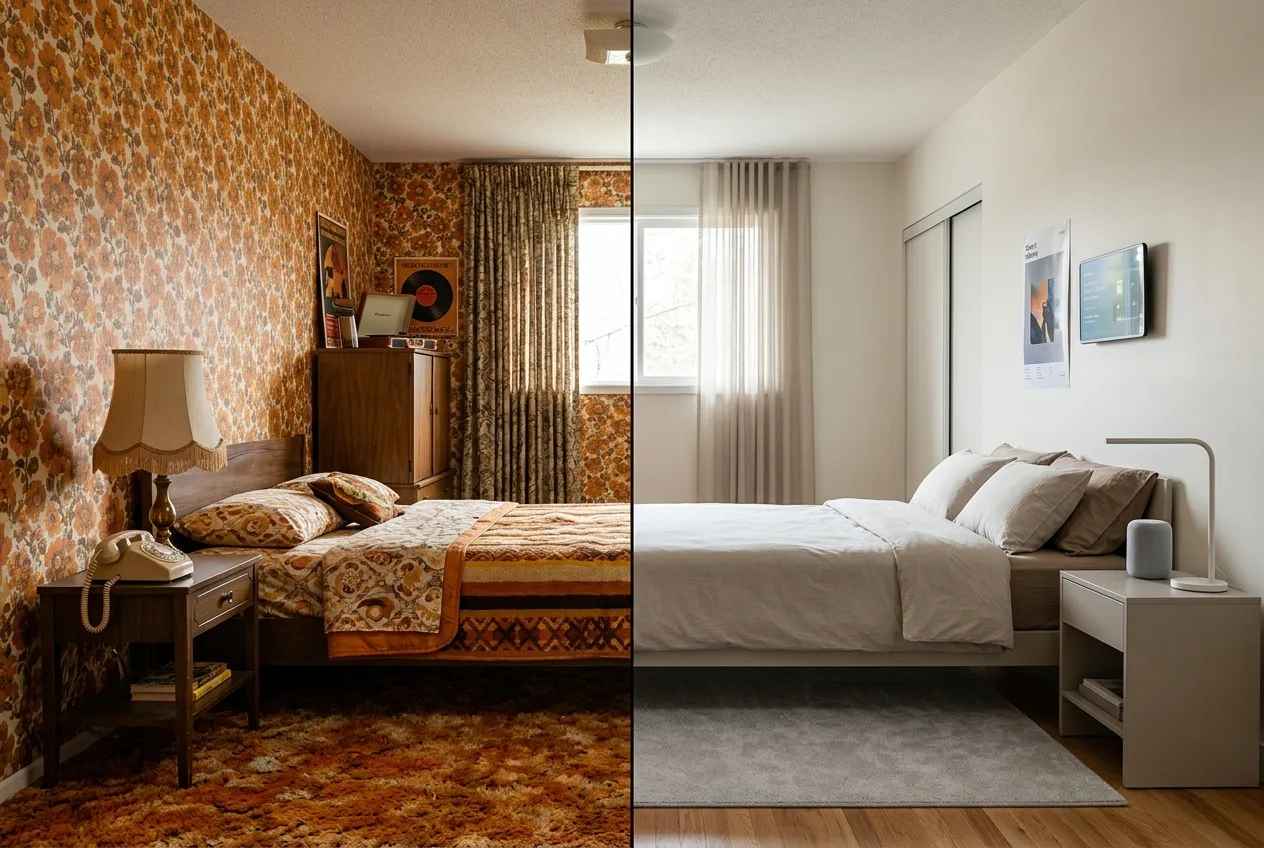
A photo of a small bedroom split exactly down the middle by a clean vertical line: the left side is 1975, with orange flowered wallpaper, a shag rug and a rotary phone and the right side is 2025, with white walls, a low platform bed and a smart speaker, in the same room from the same camera angle. Furniture positions line up across the split so the two halves read as one space. Natural daylight, realistic interior photography.
Prompts stay in English, the language these models follow best. Copy it as it is, or change a few words.
Opens Nano Banana 2.1 with this prompt and the settings below filled in.
91 tested Nano Banana prompts →
The exact price shows before you generate.
split exactly down the middle by a clean vertical line, then describe each side on its own.Furniture positions line up across the split so the two halves read as one space word for word. That phrase is what gives this result its look.{left}, in the boxes above and keep the rest word for word.Adapted from a prompt by @fofrAI, collected in PicoTrex/Awesome-Nano-Banana-images under CC BY 4.0. PopNow rewrote it as a fill-in template and made the example above.
Scene prompt guide
A small bedroom split down the middle by a clean vertical line, with one half in 1975 featuring orange flowered wallpaper and a rotary phone and the other half in 2025 with white walls and a low platform bed, is what Nano Banana 2.1 makes from this prompt. It works because both halves share one camera angle and aligned furniture, so the eye reads a single room changing across time. Natural daylight and realistic interior photography keep the result believable.
A photo of a small bedroom split exactly down the middle by a clean vertical lineThis sets the room and the one hard edge that divides it. Without the clean vertical line the image turns into a mixed-up room, so the split reads as a deliberate design choice.
the left side is 1975, with orange flowered wallpaper, a shag rug and a rotary phoneThese items set the 1975 mood with orange flowered wallpaper, a shag rug and a rotary phone. Remove the shag rug or the phone and the left half loses its era cues, so it looks like any older room.
the right side is 2025, with white walls, a low platform bed and a smart speakerThe 2025 side uses white walls, a low platform bed and a smart speaker to signal today. Changing the bed to a tall four-poster would shift the era read, while keeping the low platform bed keeps the contrast clear.
in the same room from the same camera angle.This phrase locks the camera so both halves are photographed from one spot. Delete it and the model may shift the viewpoint between sides, which breaks the sense of one room.
Furniture positions line up across the split so the two halves read as one space. Natural daylight, realistic interior photography.This line-up rule keeps the furniture at matching depths across the split, so the two halves read as one room. Natural daylight and realistic interior photography give a plain, believable look that suits a real-estate style shot.
The prompt sets one camera position and one kind of daylight, so the camera and light do most of the work here. Small changes to these two notes shift the mood without changing the split.
Swaps the daylight for warm evening lamplight, so the orange wallpaper glows and the room feels cozier.
A photo of a small bedroom split exactly down the middle by a clean vertical line: the left side is 1975, with orange flowered wallpaper, a shag rug and a rotary phone and the right side is 2025, with white walls, a low platform bed and a smart speaker, in the same room from the same camera angle. Furniture positions line up across the split so the two halves read as one space. Warm evening lamplight, realistic interior photography.
Moves the camera higher to look down across both halves, useful when you want the full floor and furniture alignment visible.
A photo of a small bedroom split exactly down the middle by a clean vertical line: the left side is 1975, with orange flowered wallpaper, a shag rug and a rotary phone and the right side is 2025, with white walls, a low platform bed and a smart speaker, in the same room from a higher camera angle above the doorway. Furniture positions line up across the split so the two halves read as one space. Natural daylight, realistic interior photography.
Keeps the same split and structure but swaps the bedroom for a kitchen, useful when you want a 1975 versus 2025 comparison in a different room.
A photo of a small kitchen split exactly down the middle by a clean vertical line: the left side is 1975, with avocado green cabinets, a checkered floor and a wall-mounted phone and the right side is 2025, with white flat-front cabinets, an induction cooktop and a smart speaker, in the same room from the same camera angle. Cabinet positions line up across the split so the two halves read as one space. Natural daylight, realistic interior photography.
Keep the 3:2 ratio, since its wide frame gives both halves of the room enough space to show their details. Keep 1k for quick tests of the split and the furniture alignment, then raise the resolution once the layout looks right. This is a text-to-image prompt, so no input picture is needed; switch to image edit only if you want to restyle a room photo you already have. For a tall phone-style image, change the ratio, but check that the split line still sits in the center.
The prompt already asks for a clean vertical line and one camera angle, which gives the model a clear brief. If the line bends or drifts, regenerate and check that the wall corners and floor edge match on both sides before you use the image.
No, this is a text-to-image prompt, so Nano Banana 2.1 builds both eras from the words alone. Upload a room photo only if you want to edit an existing room, because the split effect works from the description.
Nano Banana 2.1 can blend era details, so a smart speaker or modern lamp may drift into the 1975 half. Name the left side's objects again, for example 'no modern objects on the left side', to keep the decade clean.